The CAT4 test (Year 7 CATs): what your child will sit, and how the school uses the results
CAT4 Practice is maintained by experienced educators and is free to use. Updated
On this page
- CAT4: the main facts
- CAT4, SATs, the 11+ and other tests called "CATs"
- How schools use CAT4
- What CAT4 measures: four kinds of reasoning, eight short tests
- One example of each type of question
- How long it takes: 72 minutes or 2 hours 15 minutes?
- What happens on the day of the test
- Which version will your child sit?
- What the results look like
- Will you see the results?
- Is CAT4 an IQ test?
- Preparing for CAT4: knowing what to expect
- What to tell your child
- If your child has special needs or is learning English
- Frequently asked questions
- All our CAT4 guides
- Further reading
- Notes
CAT4 is a test of reasoning: how well your child can work things out with words, numbers and shapes. Its full name is the Cognitive Abilities Test, fourth edition, and many schools call it "CATs". It has eight short tests, each with a clock. A company called GL Assessment makes it and sells it to schools.
Many children sit CAT4 in their first weeks of The first year of secondary school in England and in British schools abroad, for children aged 11 to 12. Year 6 is the last year of primary school (age 10 to 11).. Year 7 is the first year of secondary school in England and in British schools abroad, when children are 11 to 12. The school uses the results to plan your child's teaching, and some schools use them to put children into groups for a subject. The version for Year 7 is called Level D, and our Level D page has free practice questions for it.
If your child has already sat CAT4, there is nothing to prepare for now. Your child may sit it again later: GL Assessment suggests testing again in Year 9 or 10, and some schools test in Year 9. Below, we explain how schools use the results and whether you will see them, with an email you can send to the school to ask for the results. If you have the report, our guide to CAT4 scores explains each number.
In Dubai, the KHDA oversees private schools (for what each emirate asks schools to do, see our page on CAT4 in the UAE). The KHDA requires them to give a reasoning test such as CAT4 in Years 4, 6, 8 and 10 (Grades 3, 5, 7 and 9 in schools that use grades). It also requires one for pupils who are new to the school and have no results from an earlier reasoning test. Schools can test other years as well. One school in Dubai, for example, tests all of Year 7.The Westminster School, Dubai, Our school and the UAE: CAT4 "for all students of Years 4, 6, 7, 8, 10 and all new students of Years 5 and 9".
There is no pass or fail. Each score compares your child with children of the same age, and 100 is the average. CAT4 does not test what your child learned at school, so there is nothing to study for it from school books. But the eight types of question are unusual, and a child who has seen them before knows what to do on the day. We explain our view, and GL's, under preparing for CAT4.
CAT4: the main facts
| What it tests | Four kinds of reasoning: with words (verbal), with numbers (quantitative), with shapes and patterns (non-verbal), and imagining shapes in the mind (spatial) |
| Format | Eight short tests, on a screen or, in some UK schools, on paper. Each question has five answers to choose from |
| Length | 72 minutes of test time. With instructions and practice questions, about 2 hours 15 minutes, usually in three sessions |
| When | Often at the start of Year 7. GL suggests testing again in Year 9 or 10. Younger and older children sit their own versions |
| Scores | A score for each kind of reasoning. 100 is average for your child's age, in years and months |
| Who sits it | More than 750,000 pupils a year |
| Made by | GL Assessment, which sells it only to schools |
CAT4, SATs, the 11+ and other tests called "CATs"
Three other tests are easy to confuse with CAT4.
-
National tests at the end of primary school in England (Year 6, age 10 to 11), in reading, maths, and grammar, punctuation and spelling. 100 is the expected standard. are national tests in England at the end of primary school, in Year 6, when children are 10 to 11. They test reading, maths, and grammar, punctuation and spelling: things your child has been taught. CAT4 tests reasoning instead, so a secondary school may use both.
SATs scores are also close to 100, but in SATs 100 is the expected standard, the level children are expected to reach. In 2026, by the first figures published, the average was 106 in reading and 105 in maths. In CAT4, 100 is the average itself. So a SATs score of 105 and a CAT4 score of 100 are both about average.
-
The An entrance test, taken at about age 10 or 11, for grammar schools: schools in parts of England, and in Northern Ireland, that choose pupils by test. (eleven-plus) is an entrance test for grammar schools. Grammar schools are schools in parts of England that choose their pupils by a test. The 11+ has its own papers, and it is not CAT4. In some areas, such as Buckinghamshire, GL also makes the 11+, but it is still a different test from CAT4. Some private and international schools do use CAT4 itself to choose pupils (see "To choose pupils" below).
-
A school's own "CATs". The same letters are sometimes used for tests that a school writes itself. One person on a parents' forum described a "common assessment task" as "a task that the whole year undertake". So a homework note about a "science CAT" is probably the school's own test or project. Your child can revise for that kind.
How schools use CAT4
Children arrive in The first year of secondary school in England and in British schools abroad, for children aged 11 to 12. Year 6 is the last year of primary school (age 10 to 11). from many primary schools, each with its own way of teaching and testing. CAT4 gives every child in the year the same puzzles, scored against children across the UK. This gives teachers one starting point for everyone. About half of secondary schools use CATs.
Schools use the results in four main ways.
To plan teaching
GL says the results help teachers decide "about the pace of learning that is right for a student and whether additional support or challenge is needed". In plain words: how fast to teach your child, and whether your child needs extra help or harder work.
The results can also show a need that nobody has noticed. A child with good scores on the shape tests and a low verbal score may find reading harder than reasoning. So GL recommends a reading test when the verbal score is 88 or less.
To set target grades
CAT4 gives The grades that children with similar CAT4 scores got, on average, in later national exams. They are a guide, not a promise.: the results that children with similar scores get, on average, in later exams, such as The exams most pupils in England take at age 16, one per subject, graded from 9 (highest) to 1. Older reports may show letter grades, from A* down.. GCSEs are the exams pupils in England take at age 16, one for each subject. GL says the results are used together with other information to set targets, and that its predicted grades are designed "to support target-setting". Our guide to CAT4 scores explains how much you can trust them.
To put children into sets
A A class for one subject, such as maths, where pupils are grouped by how well they are doing: a top set, a middle set and so on. Some schools move pupils between sets during the year. is a class for one subject, such as maths, where pupils are grouped by how well they are doing. Some schools use CAT4 to help decide sets. One school says it uses CAT tests together with National tests at the end of primary school in England (Year 6, age 10 to 11), in reading, maths, and grammar, punctuation and spelling. 100 is the expected standard. results. In one school that GL describes, the number tests help decide maths and science sets. That school checks every new pupil's set after eight weeks, and only 4 or 5 pupils in 100 change set.
So a child often stays in their first set. Research in England found that nearly a third of pupils were in a higher or lower maths set than their SATs results would suggest.Connolly and others (2019), The misallocation of students to academic sets in maths, British Educational Research Journal 45: 31.2% of students were in a lower or higher set than their SATs results would suggest. Education Endowment Foundation, Setting and streaming. Compared with classes where pupils of all levels learn together, sets help pupils in the higher sets a little and hold back pupils in the lower sets a little, on average. The evidence for this is very limited. If you think your child is in the wrong set, ask the school when sets are next checked.
To choose pupils
A few schools use CAT4 to decide who gets a place. Some private schools in England, such as Truro and Bromsgrove, and international schools such as Nord Anglia in Dubai use it in this way. In Tower Hamlets, in London, every child who applies for a Year 7 place sits CAT4. The scores are used to give each school a mix of children of all abilities.
What CAT4 measures: four kinds of reasoning, eight short tests
CAT4 has four parts, and GL calls each part a GL's word for one of the four parts of CAT4: verbal (words), quantitative (numbers), non-verbal (shapes and patterns) and spatial (imagining shapes in the mind). Each part has two short tests.. Each battery has two short tests.
| Battery | Test | What your child does | Minutes |
|---|---|---|---|
| Non-verbal reasoning (shapes and patterns) | Figure classification | Find the shape that belongs with three others | 10 |
| Figure matrices | See how one shape changes into another, then make the same change to a new shape | 10 | |
| Verbal reasoning (words) | Verbal classification | Find the word that belongs with three others | 8 |
| Verbal analogies | Find how two words are linked, then find a word with the same link to a third word | 8 | |
| Quantitative reasoning (numbers) | Number analogies | Find the rule that turns one number into another, then use it on a new number | 10 |
| Number series | Find the next number in a row of numbers | 8 | |
| Spatial ability (imagining shapes in the mind) | Figure analysis | Imagine a square of paper folded, with holes punched in it, then opened out | 9 |
| Figure recognition | Find a shape hidden inside an image split by a few lines | 9 |
GL publishes no count of questions for each test. Its guidance for teachers gives the most a child can score on each battery: 48 verbal, 36 number, 48 non-verbal and 36 spatial, one mark for each right answer. We divided each battery's time by these marks. By our own calculation, that gives your child about 20 seconds a question for the word tests, 25 for the shape-pattern tests, and 30 for the number tests and the spatial tests.
The non-verbal and spatial tests use no words or numbers. So CAT4 can show what a child can do even when reading, or English, holds them back in other tests.
One example of each type of question
The questions come in the order the real CAT4 test uses, and each answer explains the most tempting wrong options.
Figure classification

Which option goes with the first three?
Answer: D. Count the sides of each shape, then count the dots inside it. The triangle has 3 sides and 3 dots. The square has 4 and 4, and the pentagon 5 and 5. Only D matches: a hexagon with 6 sides and 6 dots.
E is close, with 6 sides, but it has only 5 dots. B is white like the first three, but its 4 sides hold only 3 dots.
Figure matrices

Which option completes the bottom row in the same way as the top row?
Answer: B. In the top row, the outer shape and the inner shape change places, and the small shape stays black. Make the same change to the triangle with a pentagon inside, and you get a pentagon with a small black triangle inside. C changes the places but makes the small shape white. D and E each have a shape that is not in the bottom-left figure: D has a circle inside, and E has a hexagon outside.
Verbal classification
Which word goes with these three: oak, beech, ash?
A leaf · B forest · C willow · D acorn · E wood
Answer: C, willow. Oak, beech and ash are kinds of tree, and so is willow. A leaf and an acorn are parts of a tree. A forest is many trees, and wood is what trees are made of. The wrong answers are all about trees, but only willow is a kind of tree.
Verbal analogies
page → book, as petal → ?
A stem · B garden · C seed · D flower · E bee
Answer: D, flower. A page is one part of a book. So the answer is the thing that a petal is one part of: a flower. A stem and a seed are other parts of a plant, not the whole plant. A garden has flowers in it, and a bee visits them.
Number analogies
3 → 10, 5 → 16, 8 → ?
A 16 · B 19 · C 24 · D 25 · E 26
Answer: D, 25. One rule turns the first number of each pair into the second: multiply by 3, then add 1. Check it on both pairs: 3 × 3 + 1 = 10, and 5 × 3 + 1 = 16. So 8 × 3 + 1 = 25.
C is the answer for a child who forgets to add 1. B adds 11, which works for the second pair but not for the first.
Number series
3, 5, 9, 15, 23, ?
A 29 · B 31 · C 33 · D 35 · E 46
Answer: C, 33. Write down the difference between each number and the next: 2, 4, 6, 8. Each difference is 2 more than the one before, so the next difference is 10, and 23 + 10 = 33. B adds 8 again. A and D add 6 and 12.
Figure analysis

The square is folded in half, left onto right, and a hole is punched through it. What does it look like when it is opened out?
Answer: C. The hole goes through both layers of paper, so there are two holes. When the paper opens, the second hole is the same distance from the fold line as the first, on the other side, at the same height. A forgets the second layer. B puts the second hole below the first, but the fold line runs from top to bottom, not across.
Each side of the paper above has a small mark at its middle, as in GL's own example of a folding question and in the folding questions on our level pages. The marks are not folds. They show where the middle of each side is. In our view, that can help your child judge how far a hole is from a fold.
Figure recognition

Which image hides the shape at the top? It is the same size and faces the same way: not turned round, and not a mirror image. Each of its sides is drawn in that image, as a whole line or as part of a longer line.
Answer: E. The shape is in the left part of E. Its top is part of the line across near the top. Its bottom is part of the long line that slopes gently down from the left edge to the right edge.
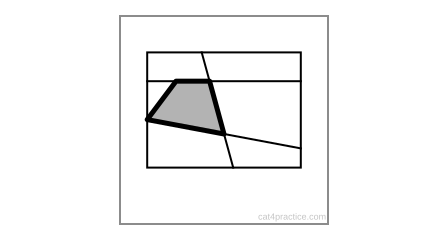
Its right side is part of the line that runs from the top edge to the bottom edge; this line is nearly upright and leans a little to the right at the bottom. Its left side is the short slanting line from the left edge up to the line across. All four sides are drawn, the shape is the same size, and it faces the same way as the shape at the top.
A has the same shape, but bigger. In B the top right corner is further to the left than in the shape at the top, so its top is shorter and its right side leans much more. C has no slanting line on the left. The black outline of image C closes the shape there instead, so its left side goes straight up and down: a different shape. D has the shape as a mirror image: its bottom slopes down to the left, and its nearly upright side is on the left.
Next time: Check which way each side goes. Here the bottom slopes gently down to the right, the left side slants up to the right, and the right side leans a little to the right at the bottom.
Our CAT4 practice test has 24 more questions like these, with a detailed explanation for each answer.
How long it takes: 72 minutes or 2 hours 15 minutes?
You may read both, and both are right.
- 72 minutes is the time on the clocks. It is the times of the eight tests, in the table under "What CAT4 measures", added together.
- 2 hours 15 minutes is GL's time for the whole test, in three sessions of up to 45 minutes. This includes the instructions read aloud, and the examples and practice questions before each test. On GL's timetable for the on-screen test, the three sessions take about 30, 41 and 41 minutes, plus time to get ready.
The sessions always come in the same order. Session 1 has the two shape-pattern tests. Session 2 has the two word tests, then number analogies. Session 3 starts with number series and ends with the two spatial tests.
GL advises schools not to give the whole test at once, "as tiredness may well impact on performance in the final tests". So a school may give the three sessions on one day with breaks, or on different days.
What happens on the day of the test
Some UK schools use paper tests. One school, The Radclyffe School, gives them to The first year of secondary school in England and in British schools abroad, for children aged 11 to 12. Year 6 is the last year of primary school (age 10 to 11). in its exam hall. Other schools use computers or tablets. On a screen, the test works like this:
- Your child logs in with a code and puts on headphones. The instructions appear on the screen and are also read aloud.
- Each test starts with an example and some practice questions. These have no clock, and your child can go through them again. This is where your child learns what to do in each test.
- Then the clock starts. A timer counts down on the screen, and no one can stop it. When the time runs out, the test moves on, finished or not.
- Nobody can skip ahead. Each test runs for its full time, so a child who finishes early waits for the clock.
- Rough paper and a pencil are given for the two number tests.
- Teachers walk around the room to check that nobody is stuck on how to answer. They cannot help with the questions.
Your child may meet questions they cannot do. GL tells pupils that "Some questions may be harder than others". The tests are "generously timed and most children reach the final questions".
Your child's The number of questions your child answered correctly. A wrong answer does not take marks away. counts only the right answers. A wrong answer takes nothing away, so a guess can only help. GL tells pupils: "Try to answer every question, but do not spend too long on ones you find difficult."
Which version will your child sit?
CAT4 comes in versions for different ages, which GL calls The version of CAT4 for an age group, named by a letter: in England and Wales, usually D for Year 7, E for Year 8, F for Years 9 and 10. Each child is compared with children of the same age.. Which level your child sits depends on their year group. In England and Wales, it is Level D for The first year of secondary school in England and in British schools abroad, for children aged 11 to 12. Year 6 is the last year of primary school (age 10 to 11)., Level E for Year 8, and Level F for Years 9 and 10. A primary school that tests Year 6 pupils before they move up may use Level C, or the next level up. Children aged about 6 to 8 sit shorter levels, with one test for each GL's word for one of the four parts of CAT4: verbal (words), quantitative (numbers), non-verbal (shapes and patterns) and spatial (imagining shapes in the mind). Each part has two short tests., so four tests instead of eight.
A later level has harder questions, but it is not harder to get a good score. Scores are always compared with children of the same age, so a typical child's score is about 100 at every level.
What the results look like
The school's report gives a The Standard Age Score is the main CAT4 score, which compares your child with children of the same age in years and months. (SAS) for each GL's word for one of the four parts of CAT4: verbal (words), quantitative (numbers), non-verbal (shapes and patterns) and spatial (imagining shapes in the mind). Each part has two short tests. (part of the test), and a The average of your child's four CAT4 scores (add them and divide by 4): one number for the whole test. The school's report may call it the mean, the mean SAS or the overall score., which is the average of the four. The SAS is the main score. 100 is average for your child's age in years and months. About half of all children score between 89 and 111, which GL calls average. Only 4 children in 100 score 127 or more.
No score is exact. Your child's real level is the score they would get on average if they could sit the test many times. GL's own figures show that, nine times in ten, the real level is within 8 to 10 points of each score, and within about 6 points of the mean score.
Reports also show:
- a How many children in 100 of the same age scored the same as your child or lower. A percentile of 84 means your child did as well as or better than 84 in 100.: how many children in 100 of the same age scored the same or lower. A percentile of 70 means your child did as well as or better than 70 children in 100;
- a One of nine bands that group CAT4 scores, from 1 (lowest) to 9 (highest). Band 5 is the middle. A score of 115 is in band 7.: one of nine bands, from 1 (lowest) to 9 (highest). Band 5 is the middle, and a score of 115 is in band 7;
- a A comparison of two CAT4 scores, verbal and spatial. The report for parents describes it in words; the school's report gives it a label, such as 'no bias' or 'mild spatial bias'.: a label that compares only the verbal and spatial scores. "No bias" means the two are about even. "Mild spatial bias" means the spatial score is a little stronger.
Our guide to CAT4 scores goes through a full example report, line by line. For any other word on the report or in the school's letter, see our CAT4 glossary.
Will you see the results?
That depends on the school. Some keep the results for teachers. One school, Workington Academy, tells parents that "Students will not receive the results directly", because the results are for teaching staff.
Other schools send home GL's report for parents. It describes each score in words: below average, average or above average. In Tower Hamlets, the scores for school places are never given to parents.
GL advises schools to talk the results through with parents, not just send them home. So it is fine to ask for a meeting. A short email to your child's class teacher or head of year is enough:
"Could you tell me whether CAT4 results are shared with parents? If they are, we would like to see the report, and to talk it through for a few minutes. We would especially like to know if the school plans to do anything because of the results."
Is CAT4 an IQ test?
Not in GL's words. GL says that One of nine bands that group CAT4 scores, from 1 (lowest) to 9 (highest). Band 5 is the middle. A score of 115 is in band 7., the nine bands, avoid the wrong idea that the scores are "IQ scores".
GL describes CAT4 as a test of "developed abilities", and says that such abilities "can be developed through experience and practice". But researchers use tests like CAT4 to measure general intelligence: a person's overall ability to reason and learn. One large study in England used an earlier version of the test in this way.
That study followed more than 70,000 children from age 11 to 16. Children with higher reasoning scores at 11 tended to get better The exams most pupils in England take at age 16, one per subject, graded from 9 (highest) to 1. Older reports may show letter grades, from A* down. results at 16, and the link was strong.Deary, Strand, Smith and Fernandes (2007), Intelligence and educational achievement, Intelligence 35. The study measured the link between reasoning at 11 and GCSE results at 16 as 0.81, where 1 would be a perfect match. Its results are given in units of the spread of scores; we converted one unit to 15 points, the same unit on CAT4's scale.
But a score at 11 did not decide a child's future. Among children of average ability at 11, 58 in 100 went on to get five or more good GCSEs (grade C or above: GCSE grades were letters then). For children who scored about 115 on CAT4's scale, it was 91 in 100. For children who scored about 85, it was 16 in 100. So some children with lower scores did well (16 in 100 at about 85), and some with higher scores did not (9 in 100 at about 115).
GL's own advice is that low scores "should never be used to put a ceiling on expectations": a low score should never limit what teachers expect of a child.
Preparing for CAT4: knowing what to expect
In our view, it helps if no type of question is new to your child on the day, whatever the test is for. There is nothing to revise for CAT4. But the eight types of question are unusual. A child who has seen them before can spend the test time on reasoning, not on working out what to do.
On the day, each test starts with a short example and some practice questions, which have no clock. Then the timed questions begin. GL Assessment, which makes CAT4, says on its page for parents that these "will familiarise the children with the style and format of the questions". Our practice questions let your child meet all eight types earlier, at home, at their own pace.
On the same page, GL advises against practice: "We strongly advise against any kind of practice ahead of a CAT4 test as this will alter the reliability of test scores."GL Assessment, CAT4: information for parents.
Research on tests like CAT4 has looked at taking a test again, and at coaching, but not at practice at home, so it cannot tell you whether practice at home changes a score. Our CAT4 practice test page explains what that research did measure, and its limits.
Some families do prepare. In the UAE, some parents help their children get to know the CAT4 format before the test. In England and Wales, about 29 in 100 secondary school pupils have had a private tutor at some point, for any subject or test.
The choice is yours. If your child does prepare, keep it short, calm and untimed at first. Our CAT4 practice test has 24 questions with explanations, and a short plan for the weeks before the test.
What to tell your child
Keep it calm and simple. Most of these sentences follow what GL tells pupils, in plainer words. The point about wrong answers is ours: the score counts only right answers.
- "It's a set of short puzzles with words, numbers and shapes. It isn't about what you learned at school."
- "Before each test there's an example and some practice questions. You can go through the practice again."
- "Each test has a clock. When the time is up, everyone moves on. Some questions are harder than others, so just do your best."
- "If you're not sure, choose the answer you think is right and move on. A wrong answer doesn't lose you anything."
- "The school uses it to understand better how you learn."
The last sentence is GL's advice to schools: to tell pupils that the results "will be used to understand better how they learn".
If your child has special needs or is learning English
Talk to the school before the test. Some help that children often get in other tests is not allowed in CAT4, and a few other arrangements are possible.
- No extra time. GL does not allow extra time, even for children who usually have it. The scores are compared with children who had no extra time.
- A reader for the instructions only. A child who usually has a reader in tests may have an adult read the instructions and examples aloud. But nobody may read the test questions to your child, so your child must read the verbal questions alone.
- Leaving out the verbal tests. If it is right for a pupil, a school may leave out the verbal tests. The other three parts still give useful results, but the report will not be complete.
- Children still learning English. The non-verbal and spatial tests do not need English. That is why GL says these two parts can be "particularly useful" for children still learning English. In one of GL's examples, a verbal score well below the other three is "quite typical" for a child learning English, and GL suggests extra help with English.
Frequently asked questions
Can you fail CAT4? No. CAT4 has no pass mark. It shows where your child stands among children of the same age. A school that uses CAT4 to choose pupils decides for itself how to use the scores.
Are there CAT4 past papers? Not from GL. Only schools can buy CAT4. So a book or website that sells "CAT4 past papers" has written its own questions in the style of CAT4. Check a few answers before you trust them.
Can my child sit CAT4 again? Only if the school decides to. If a child left many questions blank, or got very few right, GL says that testing again after at least six months might show more clearly what your child can do. GL suggests testing again in Year 9 or 10, and some schools do. If your child was ill or upset on the day, tell the school.
All our CAT4 guides
Practice questions for your child's year
Worked examples and questions of each type, every answer explained. Each level page also has a PDF of its questions, with the answers. In Year 7 (Grade 6), we suggest starting with the Level D page, then the 24 questions for more practice.
- Year 7, Grade 6, Level D
- 24 free questions, all eight types, Years 6 and 7, Grades 5 and 6
- Year 8, Grade 7, Level E
- Years 9 and 10, Grades 8 and 9, Level F
- Other years have no page yet. Our guide to the CAT4 test shows one example of each type of question. For Years 2 and 3 (Grades 1 and 2), we suggest games, not test papers.
About CAT4
- The CAT4 test, What your child will sit, the test day, and how schools use results, This page
- CAT4 in the UAE, Which grades take it, at which level, and whether it affects admission
- CAT4 in Ireland, 6th class: which level, and why it cannot decide a school place
Your child's scores
- CAT4 scores explained, What a score of 100, 115 or 130 means, and what to ask the school
- CAT4 glossary, SAS, stanine, NPR and the other words on reports and school letters
Further reading
- Yang and others (2023), Do practice tests (quizzes) reduce or provoke test anxiety? Some parents worry that practice will make a nervous child more nervous. This review of 24 studies, mostly in classrooms and some with university students, found the opposite: on average, practice tests made students less anxious about tests, not more. The authors add that the quizzes themselves may feel more stressful than other ways of learning. The studies were of quizzes on what students were learning, not reasoning tests like CAT4.
- Deary and others (2007), Intelligence and educational achievement. The study of more than 70,000 children in England described above, which compared reasoning scores at 11 with GCSE results at 16.
Notes
-
The Westminster School, Dubai, Our school and the UAE: CAT4 "for all students of Years 4, 6, 7, 8, 10 and all new students of Years 5 and 9". ↩
-
Connolly and others (2019), The misallocation of students to academic sets in maths, British Educational Research Journal 45: 31.2% of students were in a lower or higher set than their SATs results would suggest. Education Endowment Foundation, Setting and streaming. ↩
-
Deary, Strand, Smith and Fernandes (2007), Intelligence and educational achievement, Intelligence 35. The study measured the link between reasoning at 11 and GCSE results at 16 as 0.81, where 1 would be a perfect match. Its results are given in units of the spread of scores; we converted one unit to 15 points, the same unit on CAT4's scale. ↩
-
GL Assessment, CAT4: information for parents. ↩