CAT4 Level F practice questions for Years 9 and 10 (Grades 8 and 9): free, with a PDF
CAT4 Practice is maintained by experienced educators and is free to use. Updated
On this page
- Worked example first, then your child alone
- A worked example and a question for each type
- Is Level F your child's level?
- Knowing the types of question before the test day
- Level F: the same eight tests, in 72 minutes
- Our questions follow GL's description, not GL's questions
- Who sits Level F: Years 9 and 10, entrance tests and the UAE
- Parents' questions about Level F
- All our CAT4 guides
- Notes
Here are free practice questions for GL Assessment's Cognitive Abilities Test, fourth edition: for most ages, eight short timed tests of reasoning with words, numbers and shapes, and of imagining shapes in your head, in three sessions. Level F. For each of the eight types of question, there is first a worked example: a question that is already answered and explained. Then there is a question for your child to try, with a detailed explanation of the answer. Your child can do the questions on screen, or you can print them as a PDF.
CAT4 is a test of reasoning, of how well children solve puzzles with words, numbers and shapes. Level F is the version of CAT4 for children aged about 13 to 15. That means Years 9 and 10 in England and Wales, and Grades 8 and 9 in the UAE and other schools that number their years as grades. Many schools call it "CATs". A child in Year 9 or 10 may be sitting it for the second time: GL Assessment, which makes CAT4, suggests one test when children start secondary school and another two or three years later.
In Grade 8 or Grade 10? When we searched Google in the UAE in October 2026, "cat4 grade 8" brought up pages about Level E, and "cat4 for grade 10" brought up Level F pages like this one. In GL's tables, Grades 8 and 9 both take Level F, and Grade 10 takes Level G (see the table of levels). In our view, a Grade 10 child can still practise with these questions, since the eight types are the same at every level from A to G. Level G's questions are generally harder.
Worked example first, then your child alone
- Read each worked example with your child first. Then let your child try the question after it without help.
- Let your child choose before looking. When your child chooses an answer, the page shows at once whether it is right, and why each option is right or wrong.
- If your child chose a wrong answer, talk about it together, starting with why the option they chose is wrong.
- To print, use the PDF: the answers and explanations are at the back, on a new page. Give your child a pencil, an eraser and rough paper (spare paper for doing sums). On the day of the real test, children get rough paper for the two number tests (number analogies and number series).
- For more practice about a week later, try our practice test. It has 24 more questions, three of each type, with a clock if your child wants one. They are written for Levels C and D (ages 10 to 12), so they are easier than Level F's, but the eight types are the same. In studies of how students learn, practice spread out over time usually helped them remember for longer than the same practice all at once.Dunlosky, Rawson, Marsh, Nathan and Willingham (2013), Improving students' learning with effective learning techniques, Psychological Science in the Public Interest 14: of ten study techniques, practice tests and practice spread out over time were rated the most useful, in studies with students, in laboratories and in classrooms. The gap of a week is our suggestion.
A worked example and a question for each type
Figure classification
Look at the three figures (images) at the top. They are alike in some way. Which answer goes with them?
Worked example

C. In each figure a small shape sits inside a bigger one, and the small shape has one side fewer: a triangle (3 sides) inside a square (4); a diamond (4) inside a five-sided house shape (a pentagon too); a pentagon (5) inside a hexagon (6). The colour of the small shape keeps changing, so it does not matter. In C a triangle (3 sides) sits inside a four-sided shape (a trapezium).
- A: A has a square (4 sides) inside a hexagon (6 sides): two sides fewer, not one.
- B: B has a square (4 sides) inside a triangle (3 sides): the small shape has one side more, not one fewer.
- D: D has a pentagon (5 sides) inside a pentagon: the same number of sides.
- E: In E the triangle has one side fewer than the square, but it is beside the square, not inside it. In every figure at the top the small shape is inside.
Next time: When each figure has two parts, compare the parts with each other: count the sides of both, and say how the counts are linked.
Question 1

Show the answer
E. Each figure has a white arrow with three small shapes around it, and the arrow points at the shape with the most sides. In the first figure it points at the pentagon (5 sides), not the triangle (3 sides) or the square (4 sides). In the second it points at the hexagon (6 sides), not the square or the pentagon. In the third it points at the square (4 sides), not the two triangles. The colours do not matter. In E the arrow points right, at the pentagon: the pentagon has more sides than the square and the triangle.
- A: In A the arrow points at the triangle: the shape with the fewest sides.
- B: In B the arrow points at the square (4 sides), but the hexagon has 6.
- C: In C the arrow points at the pentagon (5 sides), but the hexagon has 6.
- D: In D the arrow points left, at nothing. The pentagon is on the right, at the back end of the arrow: the arrow points away from it.
Next time: When a figure has an arrow, ask what it points at, then ask what is special about that shape compared with the others in the same figure.
Figure matrices
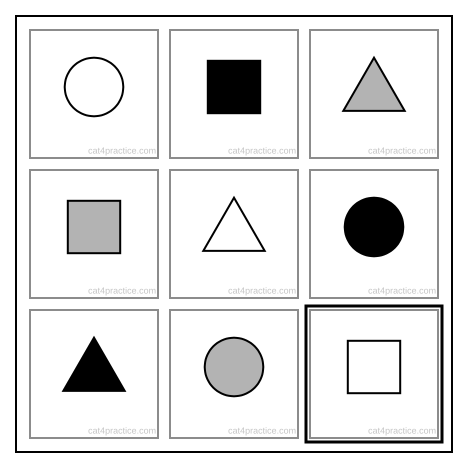
Which answer goes in the box with the question mark? Look for a pattern across each row (left to right) and down each column (top to bottom).
Worked example

A. Look along each row: it has one circle, one square and one triangle, and one white, one grey and one black shape. The bottom row already has a black triangle and a grey circle, so it is missing a square, and the missing colour is white. Check down the last column too: it has a grey triangle and a black circle, so it also needs a white square: A.
- B: B is a square, but grey: the bottom row already has a grey shape.
- C: C is white, but a circle: the bottom row already has a circle.
- D: D is a black triangle: the bottom row already has both a triangle and a black shape.
- E: E is a grey circle: a copy of a shape already in the bottom row.
Next time: In a nine-box square, check whether each row holds one of each kind. Then the missing box is whatever kind is not yet in its row, and the column should agree.
Question 2
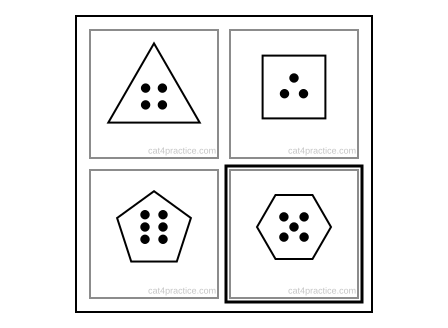
Which answer goes in the box with the question mark? The top two images show a change. Make the same change to the image on the left of the question mark.

Show the answer
C. Two things change in the top row, in opposite directions: the shape gets one more side (a triangle, 3 sides, becomes a square, 4 sides), and there is one dot fewer (4 dots become 3). Make both changes to the pentagon (5 sides) with 6 dots: a shape with 6 sides, a hexagon, with 5 dots: C.
- A: A is a hexagon, but it still has 6 dots: one dot should go.
- B: B has 5 dots, but it is still a pentagon: it has not gained a side.
- D: D has 5 dots, but 8 sides: three more sides, not one.
- E: E is a hexagon with 4 dots: two dots have gone, not one.
Next time: Count everything in the top row before and after: here one count goes up by 1 and the other goes down by 1.
Verbal classification
The three words in bold (dark letters) are alike in some way. Which answer is another one of the same kind? The answer is not the name for the whole group. For example, for pear, plum and mango, the answer would be another fruit, not the word "fruit".
Worked example
huge enormous vast
- A. size
- B. tiny
- C. immense
- D. elephant
- E. expand
C. Huge, enormous and vast all describe something very big. Immense does too: it means very big.
- A: "Size" is what the words are about, but it is a name (a noun), not a word that describes something. You can say "a vast ocean", but not "a size ocean".
- B: Tiny describes size too, but it means very small: the opposite.
- D: An elephant is huge, but "elephant" names an animal. It does not describe anything.
- E: "Expand" means to get bigger. It is something that happens (a verb), not a word that describes how big something is.
Next time: Put a word in bold into a short phrase, such as "the huge ocean". Then put each answer in its place. The right answer fits, and the phrase still means the same: "the immense ocean".
Question 3
however although yet
Show the answer
C. However, although and yet are all linking words that show a contrast: they join two ideas that are different, or that go against what you expect. "It was raining, yet we went out." Whereas shows a contrast too: "I like tea, whereas my brother likes coffee."
- A: "Because" is a linking word, but it gives a reason, not a contrast.
- B: "Therefore" is a linking word, but it shows a result: "It was raining. Therefore we stayed in."
- D: "Contrast" is the name for what each of them does, not one more of them. The answer must be one more linking word that shows a contrast.
- E: "Also" is a linking word, but it adds something of the same kind. It does not show a contrast.
Next time: For small linking words, ask how each one links the two parts of a sentence: does it give a reason, a result, more of the same, or something different?
Verbal analogies
The first two words are linked in some way. Which answer is linked to the third word in the same way?
Worked example
damp → soaked : warm →
- A. dry
- B. sun
- C. scorching
- D. cool
- E. temperature
C. Soaked is very wet: much wetter than damp. In the same way, scorching is very hot: much hotter than warm.
- A: Dry is the opposite of damp. It goes with the first word, not with "warm", and it is an opposite, not "much more".
- B: The sun makes things warm, but the sun is a thing, not a word for being hotter.
- D: Cool is the opposite of warm. The pair goes from a little to a lot of the same thing, not to its opposite.
- E: Temperature is what "warm" tells you about, not a word for being very hot.
Next time: Make a sentence for the pair: "soaked is much wetter than damp". Then use the same sentence for the third word: "___ is much hotter than warm".
Question 4
germ → disease : spark →
Show the answer
D. A germ can cause a disease: it is the small thing that starts it. A spark can cause a fire: the small thing that starts it.
- A: Electricity can make a spark, so electricity is the cause and the spark is what it causes. The answer must be what the spark causes, not what causes the spark.
- B: Striking a match makes a spark and a flame. The match comes before the spark; it is not what the spark causes.
- C: A spark is bright, but "bright" describes the spark. It is not something the spark causes.
- E: Sparks can fly off metal, but metal is not something a spark causes.
Next time: Make a sentence for the pair: "a germ causes a disease". Then try "a spark causes ___": the answer is what the third word causes, not what causes it.
Number analogies
In each pair, the second number is made from the first in the same way. Which answer completes the last pair?
Worked example
[ 4 → 19 ] [ 7 → 31 ] [ 5 → ? ]
- A. 20
- B. 23
- C. 24
- D. 29
- E. 31
B.
- Compare the first two pairs. The first numbers, 4 and 7, are 3 apart. The second numbers, 19 and 31, are 12 apart.
- 12 ÷ 3 = 4: each time the first number goes up by 1, the second number goes up by 4. Multiplying by 4 does that (4 × 4 = 16 and 7 × 4 = 28 are 12 apart too), so the rule multiplies by 4.
- Then find what else the rule does: 4 × 4 = 16, and 19 is 3 more than 16. So the rule is: multiply by 4, then add 3.
- Check it on the second pair: 7 × 4 = 28, and 28 + 3 = 31.
- Use it on 5: 5 × 4 = 20, and 20 + 3 = 23: B.
- A: 20 is 5 × 4. It does the first step and forgets the second: add 3.
- C: 24 is 5 × 5 − 1. The rule "× 5, then − 1" works for the first pair (4 × 5 − 1 = 19), but not for the second: 7 × 5 − 1 = 34, not 31.
- D: 29 is 5 + 24. Adding 24 works for the second pair (7 + 24 = 31), but not for the first: 4 + 24 = 28, not 19.
- E: 31 is copied from the second pair. It does not come from 5.
Next time: When adding the same number does not fit both pairs, compare them: divide how far apart the second numbers are by how far apart the first numbers are. That is the number to multiply by.
Question 5
[ 9 → 5 ] [ 21 → 9 ] [ 33 → ? ]
Show the answer
B. Two steps: add 6, then divide by 3. 9 + 6 = 15, and 15 ÷ 3 = 5. 21 + 6 = 27, and 27 ÷ 3 = 9. So 33 + 6 = 39, and 39 ÷ 3 = 13. The same rule can also be written with the steps the other way round, but then the number changes: divide by 3, then add 2 (adding 6 before ÷ 3 is the same as adding 6 ÷ 3 = 2 after). Check: 9 ÷ 3 + 2 = 5, and 21 ÷ 3 + 2 = 9. Both rules give 13: 33 ÷ 3 + 2 = 13.
- A: 17 is 33 ÷ 3 + 6: it swaps the two steps but still adds 6. Check on the first pair: 9 ÷ 3 + 6 = 9, not 5. Dividing first works only if you then add 2.
- C: 11 is 33 ÷ 3: it does only one of the two steps. Check on the first pair: 9 ÷ 3 = 3, not 5.
- D: 29 is 33 − 4. Taking away 4 works for the first pair (9 − 4 = 5), but not for the second: 21 − 4 = 17, not 9.
- E: 21 is 33 − 12. Taking away 12 works for the second pair (21 − 12 = 9), but not for the first: 9 − 12 is below zero, not 5.
Next time: With two steps, check your rule on both pairs before you choose. If you swap the steps, the number you add changes: add 6, then ÷ 3 is the same rule as ÷ 3, then add 2.
Number series
These numbers are a series: they follow a rule. Which number comes next?
Worked example
5 7 11 17 25 →
- A. 27
- B. 33
- C. 35
- D. 37
- E. 50
C. Write the jump from each number to the next: + 2, + 4, + 6, + 8. The jumps are not the same, but they grow by 2 each time. So the next jump is + 10, and the next number is 25 + 10 = 35.
- A: 27 is 25 + 2: it starts the jumps again from + 2. The jumps keep growing.
- B: 33 is 25 + 8: it repeats the last jump. Each jump is 2 more than the one before.
- D: 37 is 25 + 12: the jump grows by 4 here, not by 2.
- E: 50 is 25 × 2. The numbers are not doubling: 5 × 2 = 10, not 7.
Next time: If the jumps are not all the same, write them in a row under the numbers and look for a rule in the jumps.
Question 6
1 5 13 29 61 →
Show the answer
D. Each number is double the one before, plus 3: 1 × 2 + 3 = 5, 5 × 2 + 3 = 13, 13 × 2 + 3 = 29, 29 × 2 + 3 = 61. So the next number is 61 × 2 + 3 = 125. (The jumps show it too: + 4, + 8, + 16, + 32 double each time, so the next jump is + 64, and 61 + 64 = 125.)
- A: 64 is the next jump (the amount added), not the next number. Add it to 61: 61 + 64 = 125.
- B: 93 is 61 + 32: it repeats the last jump. The jumps double each time.
- C: 122 is 61 × 2. It doubles but forgets to add 3.
- E: 183 is 61 × 3. The numbers are not multiplied by 3: 5 × 3 = 15, not 13.
Next time: When the numbers grow faster and faster, try "double it, then add or take away a small number" on the first few.
Figure analysis
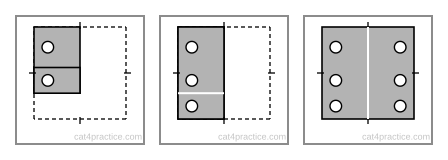
A square of paper is folded. Then one or more holes are punched through the folded paper, through every layer. Which answer shows the paper when it is unfolded?
Worked example

E.
- Count the layers under each hole. The lower hole goes through the strip (the bottom part, folded up) too: 4 layers, so 4 holes. The upper hole is above the strip: 2 layers, so 2 holes.
- Unfold the strip: the hole in the strip comes down with it, to below the strip's fold line, as far below that line as the lower hole is above it.
- Unfold the first fold, the fold in half down the middle: every hole gets a matching hole in the right half, as far from the middle as the hole is.
- That makes 6 holes, each pair the same distance from the middle line: E. C has 6 holes too, but they are not mirrored.
- A: A forgets the strip: the lower hole needs a matching hole in the strip.
- B: B forgets the fold in half: the right half needs holes too.
- C: C copies the holes into the right half without flipping them, so they are too near the middle of the paper. A fold makes a mirror image.
- D: D copies the holes into the right half without flipping them, and forgets the strip.
Next time: Before you unfold, count the layers under each hole. A fold that covers only part of the paper adds layers only there.
Question 7

Show the answer
A. Layers: two folds, so 4 layers: 4 holes. Unfold the second fold: the hole gets a matching hole across that fold line, near the left edge. Unfold the first fold: both holes get a matching hole across the first fold line. The holes make two pairs, one in the bottom right quarter and one in the top left quarter: A.
- B: B forgets the second fold: only 2 holes.
- C: C turns the hole round the middle of the square, a quarter turn at a time, instead of flipping it. Here the holes come in two pairs, one pair in each of two opposite quarters.
- D: D flips the holes across a line straight down the middle and a line straight across the middle, but both fold lines slope: the first runs from corner to corner, the second from a corner to the middle of the square.
- E: E flips the hole across a line straight across the middle for the second fold, but that fold line slopes, like the first one: it runs from a corner to the middle of the square.
Next time: A fold makes a mirror image, not a turned copy. Flip the holes across one fold line at a time, last fold first.
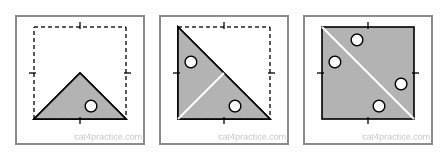
Figure recognition
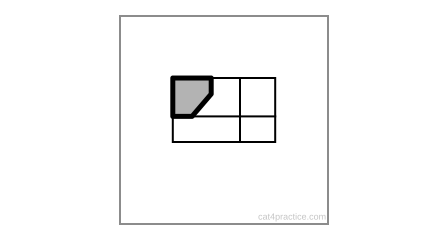
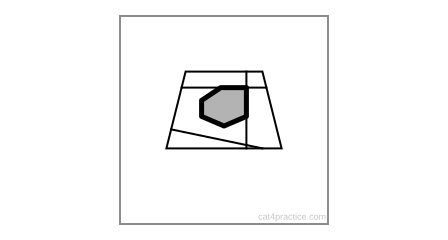
Which image hides the shape at the top? It is the same size and faces the same way: not turned round, and not a mirror image. Each of its sides is drawn in that image, as a whole line or as part of a longer line. (In the real test, the shape is drawn below the five images.)
Worked example

D. The shape is in the top left of D. Its top and left sides are parts of the edges of the black rectangle; the short line going down from the top, the sloping line and the line across make the rest. Like the shape at the top, its cut-off corner is at the bottom right, and the cut is a long one.
- A: A has the shape as a mirror image: its cut-off corner is at the bottom left.
- B: B has the same shape, but bigger: about one and a half times as wide and as tall.
- C: C has the shape as a mirror image from top to bottom (like a reflection in water): its cut-off corner is at the top right.
- E: E has a shape whose cut-off corner is much smaller: its sloping side is short.
Next time: Find the most unusual side of the shape first (here, the sloping cut). Look for a line in each image that slopes the same way and is the same length, then check the other sides.
Question 8

Show the answer
B. The six-sided shape is in the middle of B. Its flat top is part of the line across just below the top edge of the black trapezium. That line goes all the way across, to the sloping left and right sides of the trapezium. Its upright right side is part of the long upright line. Its other four sides are short sloping and upright lines. Its bottom point is in the middle, halfway between its left and right sides, as in the shape at the top.
- A: A has the shape turned half way round: its bottom point is at the top.
- C: C has the shape as a mirror image: its long upright side is on the left.
- D: D has a shape whose bottom point is much further left, only a quarter of the way across.
- E: E has the same shape, but bigger: about one and a half times as wide and as tall.
Next time: With six sides, check the corners in order round the shape. A near copy usually has one corner in a different place.
Is Level F your child's level?
| Level E | Level F | Level G | |
|---|---|---|---|
| Usual age | 12 to 13 | 13 to 15 | 15 and over |
| England and Wales | Year 8 | Years 9 and 10 | Year 11 and above |
| Scotland | S2 | S3 and S4 | S5 and S6 |
| Northern Ireland | Year 9 | Years 10 and 11 | Year 12 and above |
| UAE, and other schools with grades | Grade 7 | Grades 8 and 9 | Grades 10 and 11 |
American, Indian and International Baccalaureate (IB) schools use the same grade numbers as the table's UAE row. Schools in the UAE that follow the UK curriculum use years, as in England. In the Republic of Ireland, GL puts 2nd Year and 3rd Year of secondary school on Level F (see CAT4 in Ireland).
In England and Wales, Level F covers two school years, where Levels A to E cover one each. So a Year 9 child and a Year 10 child may sit the same test, and each is scored against children of their own age.
The school chooses the The version of CAT4 for an age group, named by a letter: in England and Wales, usually D for Year 7, E for Year 8, F for Years 9 and 10. Each child is compared with children of the same age.. Most schools follow GL's table of levels, and GL says that other choices are unusual.GL Assessment, Choosing a test type and level (UK), and for grades, Choosing a test type and level (international). One such choice is the next level up, for children tested before they change schools. So a child who sits CAT4 in Year 8, for a place in Year 9 at a new school, may sit Level F, not Level E.
If the school gives you your child's CAT4 report, the level is printed at the top, as "Level: F". It is the name of the version, not a score. If you are not sure which level your child will sit, ask the school.
If this is not your child's level, see the list at the end of this page.
Knowing the types of question before the test day
In our view, it helps your child to have met each type of question before the test day. In the real test, each of the eight tests starts with an example and a few practice questions, with no clock. GL says these "will familiarise the children with the style and format of the questions".GL Assessment, CAT4: information for parents. The questions on this page show the same eight types earlier, at home.
GL makes CAT4 for schools, and it advises against any practice before the test. Our guide to the test gives GL's advice in its own words. The choice is yours.
We found no study of what practice at home, like the questions on this page, does to CAT4 scores. A large review of studies of tests like CAT4, with school pupils as well as adults, did not measure it either. Our practice guide explains what that review did measure, and its limits.
Level F: the same eight tests, in 72 minutes
Level F has the same eight short tests as every level from A to G, in three sessions. Each test has a strict time limit, and on screen, a timer that cannot be stopped counts down. The tests come in pairs, and each pair is one of CAT4's four parts, called GL's word for one of the four parts of CAT4: verbal (words), quantitative (numbers), non-verbal (shapes and patterns) and spatial (imagining shapes in the mind). Each part has two short tests.. Your child's report gives a score for each battery, named for what it reasons with: verbal for words, quantitative for numbers, non-verbal for shapes and patterns, and spatial for shapes your child must imagine.
The names of the tests are GL's, as printed on the report, and "figure" means an image.
- Figure classification: finding the image that shares something with three others.
- Figure matrices: seeing how one image changes in a grid, then making the same change to another.
- Verbal classification: finding a word of the same kind as three given words.
- Verbal analogies: seeing how two words are linked, then finding a word linked in the same way to a third.
- Number analogies: finding how the second number of a pair is made from the first, then completing another pair the same way.
- Number series: finding the next number in a row.
- Figure analysis: imagining a square of paper being folded, punched with holes and opened out, and choosing how it looks.
- Figure recognition: finding which image hides a given shape.
| Session | Tests, by battery | In the real test | About how long for one question (our estimate) |
|---|---|---|---|
| 1 | Non-verbal: figure classification and figure matrices | 10 minutes each | 25 seconds |
| 2 | Verbal: verbal classification and verbal analogies | 8 minutes each | 20 seconds |
| 2 | Quantitative: number analogies | 10 minutes | 30 seconds |
| 3 | Quantitative: number series | 8 minutes | 30 seconds |
| 3 | Spatial: figure analysis and figure recognition | 9 minutes each | 30 seconds |
| All eight | 72 minutes |
How we worked out the time for one question
How many questions each test has is not published. GL's guidance for teachers has a table of the highest number of marks a child can get on each battery (each pair of tests), with one mark for each right answer. The highest is 48 for verbal, 48 for non-verbal, 36 for quantitative and 36 for spatial, and the table does not say which levels it is for.
We divided each pair's time by its marks. The two non-verbal tests have 20 minutes for 48 marks: 25 seconds a question. The two quantitative tests have 18 minutes for 36 marks: 30 seconds a question, for number series as well as number analogies. The real time for one question may be different in each test. These marks are not CAT4 scores: a score shows how your child did compared with others of the same age, and the middle score is 100.
Harder words, two-step number questions, and screen or paper
- Some number analogies may need two steps, such as doubling and then adding 1: 4 becomes 9, and 6 becomes 13. These start at Level C, so they can come up in Level F.
- The words are chosen for each level. GL's own example: "windy" might be used at Level A, but "hurricane" at Level E.
- The test may be on a screen or on paper, depending on the school, so ask if you want to know. GL lists its paper version for the UK, and offers it to schools in Ireland too. In Dubai, the rules allow only tests on screen. On paper, children mark their answers in pencil on a separate answer sheet.
Our questions follow GL's description, not GL's questions
We wrote every question ourselves, to match GL's description of each type. None of them is GL's, and GL does not recommend any practice materials, including these questions. The types come in the order the real test uses. We chose each question to show something that its worked example does not.
The real test has many more questions of each type, and some are harder than others. So one question shows your child what each type of question is like, not how they will do in the real test.
Who sits Level F: Years 9 and 10, entrance tests and the UAE
- In Year 9 or Year 10. In the UK, CATs are not compulsory, and Parentkind, a parents' charity, says about half of secondary schools use them. GL suggests a second test in Year 9 or 10 to bring each child's The grades that children with similar CAT4 scores got, on average, in later national exams. They are a guide, not a promise. for The exams most pupils in England take at age 16, one per subject, graded from 9 (highest) to 1. Older reports may show letter grades, from A* down. and Exams taken mainly at age 18, after two years of study, one for each subject, graded from A* (highest) to E. up to date. Pupils usually choose their GCSE subjects in Year 9 (in Northern Ireland, sometimes Year 10), and GL says that the predicted grades can also help with that choice. Some schools test the whole of Year 9, to set GCSE targets or to place children in teaching groups.
- For a place at a school. Some schools use CAT4 in their entrance test. In England, some fee-paying schools use it for entry to Year 9, at 13, often called 13+ entry. Some international schools, such as one in Dubai, also use it for a place in Year 9.
- In the UAE. In every emirate except Abu Dhabi, the latest rules we found ask private schools to test Grades 3, 5, 7 and 9 with CAT4 or a test like it.GL Education (the group GL Assessment belongs to), Testing in the UAE: each emirate's rules and GL's level tables, including for Indian-curriculum (CBSE) schools in Dubai. For Dubai, KHDA, External benchmark assessments requirements, 2026-2027. Those grades take Levels A, C, E and F. In Abu Dhabi, a test like CAT4 is the school's choice. Our page on CAT4 in the UAE has each emirate's rules.
So outside Abu Dhabi, a Grade 9 child (Year 10 in schools that use years) is likely to sit Level F, or another test of the same kind.
Grades 3, 5, 7 and 9 do not include Grade 8, so a Grade 8 child might not sit CAT4 at all. A Grade 8 child sits it, at Level F, in cases like these:
- The child is new to a school in Dubai that uses CAT4, and has no results from an earlier reasoning test.
- The school is new and has not tested reasoning before: Dubai's rules ask such schools to test every grade from 3 to 9, and GL advises the same.
- The school tests other grades, Grade 8 among them.
- The child is applying to a school that uses CAT4 in its entrance test.
If none of these applies, ask the school whether your child will sit CAT4 this year.
In the UAE, scores compare your child with UK children of the same age. Schools that follow CBSE, a curriculum from India, may use a CBSE edition of CAT4 instead. It compares each child with the results of more than 12,000 children who follow that curriculum, and gives an idea of their likely results in the Grade 10 and Grade 12 exams.
Parents' questions about Level F
Can I download Level F questions as a PDF? Yes, as a PDF, with the answers at the back. There are no official practice papers to download: GL sells CAT4 only to schools, and its own practice questions come in the real test, a few before each of the eight tests. GL also has a short video for pupils.GL Education, Student pre-testing essentials: a short video for pupils, before they sit CAT4.
My child will sit CAT4 for a place at a new school: how should they prepare? In our view, the same as for any CAT4 test: practise until no type of question is new, then practise some questions with a clock. Our practice guide has a three-week plan. One school we found says that no preparation is needed for its entrance tests, so ask the school what it expects.
My child sat CAT4 in The first year of secondary school in England and in British schools abroad, for children aged 11 to 12. Year 6 is the last year of primary school (age 10 to 11).: will the Year 9 score be the same? Probably close, but not the same. In a GL study, 3,883 pupils sat Level D and then Level F two years later.GL Assessment, CAT4 UK technical report, section on the consistency of scores: the Level D and Level F study, with how much the mean score changed and how closely each of the four scores matched. For 9 in 10 of them, the The average of your child's four CAT4 scores (add them and divide by 4): one number for the whole test. The school's report may call it the mean, the mean SAS or the overall score. (the average of the four scores) changed by 10 points or less. Each of the four scores (verbal, quantitative, non-verbal and spatial) can change more than that, and our scores guide shows how much change is normal.
Does Level F predict my child's The exams most pupils in England take at age 16, one per subject, graded from 9 (highest) to 1. Older reports may show letter grades, from A* down. grades? Not exactly: many reports show The grades that children with similar CAT4 scores got, on average, in later national exams. They are a guide, not a promise., the grades that children with CAT4 scores like your child's got in their GCSEs. They assume average progress in a typical school, and GL tells teachers to explain that they are an estimate from numbers, not a promise. If your child's GCSE targets came from a Year 7 test, a Year 9 test gives the school newer predicted grades, so ask whether it will use them. Our scores guide explains how to read them.
Can an older child be given a harder level? Usually not, because schools choose the level by year group, from GL's table, not by each child's age. A harder level is not meant to give a lower score: at every level, your child's score compares them with others of the same age, in years and months. One limit: Level F's scores are worked out for children aged 12 years 6 months to 15 years 11 months. A child older than that is scored as if they were 15 years 11 months old, and a younger child as if they were 12 years 6 months old.
My child freezes when a clock is on the screen: what can help? Add the clock step by step on our practice test: first three questions of one type with "Time this set", then all 24 with "Time all 24 questions". In the real test, the practice questions before each test have no clock, and your child can do them again, so they can get used to the questions before the timer starts. When a test's time is up, it ends, finished or not, so practise leaving a hard question and going on to the next one.
How long does Level F take? GL allows about 2 hours 15 minutes, in three sessions, with the instructions and practice questions. The eight tests themselves take 72 minutes.
Are the word questions read aloud? No. On screen, the instructions are read aloud, but your child reads the word questions alone.
Can I work out my child's CAT4 score from these questions? No. For a real score, GL compares your child's answers with those of a large group of UK children of the same age. Questions done at home cannot do that. In our view, what these questions can show is which types are new to your child.
My child has already sat it: what now? Not every school sends the results home. Some keep them for teachers, so you may need to ask. On the report, 100 is the middle score for your child's age, and scores from 89 to 111 cover about half of all children.
If your child was unwell or upset that day, tell the school. If your child left many questions unanswered, or answered most but got few right, GL tells schools to treat the score with caution. It says that testing again at least six months later may show more of what your child can do. Our scores guide explains each part of the report, and what to ask the school.
All our CAT4 guides
Practice questions for your child's year
Worked examples and questions of each type, every answer explained. Each level page also has a PDF of its questions, with the answers. In Year 7 (Grade 6), we suggest starting with the Level D page, then the 24 questions for more practice.
- Year 7, Grade 6, Level D
- 24 free questions, all eight types, Years 6 and 7, Grades 5 and 6
- Year 8, Grade 7, Level E
- Years 9 and 10, Grades 8 and 9, Level F, This page
- Other years have no page yet. Our guide to the CAT4 test shows one example of each type of question. For Years 2 and 3 (Grades 1 and 2), we suggest games, not test papers.
About CAT4
- The CAT4 test, What your child will sit, the test day, and how schools use results
- CAT4 in the UAE, Which grades take it, at which level, and whether it affects admission
- CAT4 in Ireland, 6th class: which level, and why it cannot decide a school place
Your child's scores
- CAT4 scores explained, What a score of 100, 115 or 130 means, and what to ask the school
- CAT4 glossary, SAS, stanine, NPR and the other words on reports and school letters
Notes
-
Dunlosky, Rawson, Marsh, Nathan and Willingham (2013), Improving students' learning with effective learning techniques, Psychological Science in the Public Interest 14: of ten study techniques, practice tests and practice spread out over time were rated the most useful, in studies with students, in laboratories and in classrooms. The gap of a week is our suggestion. ↩
-
GL Assessment, Choosing a test type and level (UK), and for grades, Choosing a test type and level (international). ↩
-
GL Assessment, CAT4: information for parents. ↩
-
GL Education (the group GL Assessment belongs to), Testing in the UAE: each emirate's rules and GL's level tables, including for Indian-curriculum (CBSE) schools in Dubai. For Dubai, KHDA, External benchmark assessments requirements, 2026-2027. ↩
-
GL Education, Student pre-testing essentials: a short video for pupils, before they sit CAT4. ↩
-
GL Assessment, CAT4 UK technical report, section on the consistency of scores: the Level D and Level F study, with how much the mean score changed and how closely each of the four scores matched. ↩