CAT4 practice test: 24 free questions with detailed explanations
CAT4 Practice is maintained by experienced educators and is free to use. Updated
On this page
- How to use this test
- Non-verbal reasoning: shapes and patterns
- Verbal reasoning: words
- Quantitative reasoning: numbers
- Spatial ability: imagining shapes in the mind
- Quick answer key
- What your child's result here tells you
- Before the test: getting to know the questions
- A three-week plan
- Ages 6 to 8: games, not test papers
- CAT4 tomorrow? What to do tonight
- Frequently asked questions
- All our CAT4 guides
- Further reading
- Notes
This page has 24 practice questions for CAT4, the reasoning test that many schools call "CATs". We wrote them for children of about 10 to 12, in Year 6 or The first year of secondary school in England and in British schools abroad, for children aged 11 to 12. Year 6 is the last year of primary school (age 10 to 11). (Grade 5 or 6). For each of CAT4's eight types of question, there is a worked example to read with your child, then three questions for your child to try alone. The answers stay hidden until your child has chosen, and each explanation also says why the wrong options are wrong. Everything is free, and there is nothing to sign up for.
In Year 7 (Grade 6), we suggest starting with our Level D page, because its questions are written only for Level D, the version of CAT4 for that year. Then come back to these 24 questions for more practice. For another year, or to print questions with answers, use our page for your child's year. Each has a worked example and a question for each type, and a free PDF that ends with the answers:
- Year 7, Grade 6, Level D
- Year 8, Grade 7, Level E
- Years 9 and 10, Grades 8 and 9, Level F
- Other years have no page yet. Our guide to the CAT4 test shows one example of each type of question. For Years 2 and 3 (Grades 1 and 2), we suggest games, not test papers.
CAT4 does not test school subjects, so there is nothing to study for it from school books. But its questions are unusual. On the day, each test gives a short example and some practice questions, and then the clock starts. A child who has already seen each type of question can spend that time thinking, not working out what to do.
We wrote these questions ourselves, to match GL Assessment's description of each test. GL is the company that makes CAT4, and it sells the test only to schools. GL makes a version of CAT4 for each age group, and calls each one a level. GL shows a few example questions in its reports and in a short video for pupils.
In each set of three, the first question is the easiest and the third is the hardest.
How to use this test
- Do the worked examples together. Read the question, let your child try it, then read the explanation together.
- Do not use a timer at first. On the day, each test also starts with practice questions that have no clock.
- Keep a pencil and some paper nearby for the number questions. On the day, children get scrap paper for the two number tests.
- Open the answer only after your child has chosen. Then read why each wrong option is wrong, especially the one your child chose.
- To feel the real speed, allow about 25 seconds a question for the shape-pattern tests, 20 for the word tests and 30 for the number tests and the folding and hidden-shape tests. We worked this out from GL's times and the highest possible mark on each part. At that speed, the 24 questions here take 10½ minutes.
When your child is ready for the clock, press "Time all 24 questions", below. It starts a timed test of the 24 questions: eight short tests, in the same order as the real test, each with its own clock. It shows one question at a time, and the results at the end. To time just one set of three, press "Time this set" at the start of that set.
10 min 30 s, about the real test's pace
Non-verbal reasoning: shapes and patterns
CAT4 has four groups of tests, and GL calls each group a GL's word for one of the four parts of CAT4: verbal (words), quantitative (numbers), non-verbal (shapes and patterns) and spatial (imagining shapes in the mind). Each part has two short tests.. Each battery has two tests. Below, they come in the same order as in the real test.
On the day: 48 questions in 20 minutes, in Part 1.
Figure classification
Three figures follow the same rule. Choose the option that follows it too.
Worked example

First look for what stays the same in all three figures, then for what changes. Each figure is a large white shape with a small black shape inside. The large shapes are different: a triangle, a circle and a square. But the small shape is always the same kind of shape as the large one.
In A, C, D and E, the small shape is different from the large one. B is a hexagon with a small hexagon inside.
Answer: B. There is no hexagon in the first three figures, and that does not matter. The rule is about how the two shapes go together, not about which shapes they are.
1 min 15 s, about the real test's pace
Question 1

Show the answer
C. Each of the three figures has four straight sides: a square, a square turned onto one corner, and a four-sided shape with no equal sides. Only C, a rectangle, also has four sides. A has five sides, B three and D six, and E, a circle, has no straight sides at all.
D is white like the first three, but it has six sides.
Next time: with plain shapes, count the sides first.
Question 2

Show the answer
E. In each figure, exactly half is grey: 2 parts of 4, 1 of 2, and 3 of 6. E has 4 of 8 parts grey, which is also half. A has 3 of 8, B 1 of 4, C 2 of 6 and D 2 of 3.
Next time: when a shape is cut into parts, count all the parts, then count the grey ones.
Question 3

Show the answer
C. In each figure, the grey shape is the one with the most sides: the pentagon, then the hexagon, then the pentagon again. In C, the grey shape is a hexagon, which has more sides than the square and the triangle next to it.
Size does not matter here. The grey shape is middle-sized in the first figure, the smallest in the second, and the largest in the third.
A makes the pentagon grey, but its hexagon has more sides. E makes the square grey, but its pentagon has more sides. B makes the triangle grey, which has the fewest sides, and D has two grey shapes.
Next time: when a box has several shapes, ask what makes the special one different from the others in the same box.
Figure matrices
A matrix is a grid of boxes. The top row shows a change. Which option completes the bottom row in the same way?
Worked example

Work out exactly what happened to the flag. The pole stood upright and now lies flat, with its top on the right. The flag pointed right and now points down. That is a quarter turn to the right, like a clock hand moving from 12 to 3.
Give the triangle the same quarter turn. Its bottom side moves round to the left side, and the square corner moves from the bottom left to the top left. That is D.
A is a quarter turn the other way. B is turned half way round. C is a mirror image, and E has not changed at all.
Answer: D. To check a turn, follow one corner. Here, follow the square corner.
1 min 15 s, about the real test's pace
Question 4

Show the answer
D. The triangle gets bigger, and its shape and colour stay the same. So the grey pentagon gets bigger and stays grey. A has become black, and B has not got bigger. C has become a hexagon, and E has become white.
Next time: say what the change is, then check that nothing else has changed.
Question 5

Show the answer
A. Two things change in the top row: there is one more shape, and white becomes black. So four white triangles become five black triangles. B does not change the colour, and C does not add a shape. D changes the shape, and E makes the triangles grey, not black.
Next time: sometimes two things change at once. Check every option for both changes.
Question 6

Show the answer
C. Two things change. The square becomes grey. And the black triangle moves from the top left corner to the top right corner, still pointing up: one corner round the box, in the direction a clock's hands move. So the rectangle becomes grey, and the triangle moves one corner in the same direction, from the bottom right to the bottom left.
A becomes grey and moves the triangle, but the triangle has become white. B moves the triangle but stays white. D stays white and leaves the triangle where it was. E's triangle points down, but in the top row the triangle keeps pointing up.
Next time: choose one small part, follow it from box to box, and say which way it moves.
Verbal reasoning: words
On the day: 48 questions in 16 minutes, in Part 2.
Verbal classification
Three words belong together. Which option belongs with them?
Worked example. whisper, mutter, mumble
- A. shout
- B. speak
- C. murmur
- D. listen
- E. silence
First say what the three words share, as exactly as you can. Each is a way of speaking quietly or not clearly.
Now test each option. Shout is speaking, but loudly. Speak means any talking, so it is too general. Murmur means speaking softly: it fits. Listen is hearing, not speaking, and silence means no sound at all.
Answer: C. In our questions, the wrong options are often words that are linked to the three words but are not the same kind of thing.
1 min, about the real test's pace
Question 7. apple, pear, plum
Show the answer
D, cherry. Apples, pears and plums are fruits, and so are cherries. A carrot is a vegetable and bread is a food, but neither is a fruit. A tree is where fruit grows, and juice is made from fruit.
Next time: say what the three words share before you read the options.
Question 8. violin, cello, harp
Show the answer
A, guitar. A violin, a cello and a harp are all musical instruments with strings, and so is a guitar. You hit a drum, and you blow into a flute and a trumpet. A bow is used to play a violin or a cello, but it is not an instrument.
Next time: "musical instruments" is too wide a group here. Make the group as small as the three words allow.
Question 9. reduce, lessen, shrink
Show the answer
E, decrease. All three words mean "make or become smaller", and so does decrease. Small is close in meaning, but it is a describing word, not an action word like the other three. Expand means the opposite. Remove means take away completely, and measure is a different action.
Next time: check what kind of word it is, as well as what it means.
Verbal analogies
Find the link between the first two words. Then choose the word that has the same link with the third word.
Worked example. bird → nest, as bee → ?
- A. honey
- B. hive
- C. flower
- D. wasp
- E. pollen
Put the link into a sentence: "a nest is a bird's home". Then use the same sentence with the third word: "a ___ is a bee's home". Hive fits.
Honey is the most tempting wrong answer, because it is the word most linked to bees. But honey is not a home. A flower is where bees find food, a wasp is an insect like a bee, and pollen is the yellow dust that bees carry from flower to flower.
Answer: B. Saying the link as a sentence stops your child choosing the first word that "goes with" bee.
1 min, about the real test's pace
Question 10. hot → cold, as up → ?
Show the answer
A, down. Cold is the opposite of hot, so the answer is the opposite of up. High and top mean nearly the same as up, the sky is up, and warm goes with hot, not with up.
Next time: put the link into words first ("is the opposite of", "lives in", "is made by"). Only then look for a match.
Question 11. fast → faster, as good → ?
Show the answer
B, better. Faster means "more fast", so the answer means "more good", which is better. Best means "most good", not "more good". Well describes how you do something, and quick and kind change the meaning.
Next time: when the link is about the form of a word, keep the meaning and change only the form.
Question 12. thermometer → temperature, as clock → ?
Show the answer
D, time. A thermometer measures temperature, so the answer is what a clock measures: time.
Minute is the most tempting wrong answer. A minute is a unit of time, but the first pair has the thing measured ("temperature"), not a unit ("degrees"). Hands are part of a clock, an alarm is something a clock may have, and a watch is another kind of clock.
Next time: match the exact link. "What it measures" and "a unit it uses" are different links.
Quantitative reasoning: numbers
On the day: 36 questions in 18 minutes. Number analogies comes at the end of Part 2, and number series at the start of Part 3.
Number analogies
One rule turns each first number into the second number. Find the rule, then use it on the third number.
Worked example. 2 → 5, 6 → 13, 4 → ?
- A. 8
- B. 9
- C. 10
- D. 11
- E. 7
Find a rule that works for the first pair, then check it on the second pair. "Add 3" turns 2 into 5. But 6 + 3 is 9, not 13, so "add 3" is wrong. "Multiply by 2, then add 1" turns 2 into 5, and 6 × 2 + 1 = 13, so it works. Then 4 × 2 + 1 = 9.
Each wrong option comes from a rule that does not work for both pairs. A multiplies by 2 but forgets to add 1. E adds 3. D adds 7, which works only for the second pair. C fits no rule.
Answer: B. Always check a rule on the second pair before you use it.
1 min 30 s, about the real test's pace
Question 13. 3 → 6, 7 → 10, 12 → ?
Show the answer
B, 15. The rule is "add 3": 3 + 3 = 6 and 7 + 3 = 10, so 12 + 3 = 15. C, 24, is the most tempting wrong answer: "multiply by 2" works for 3 → 6 but not for 7 → 10. A adds 2, D takes away 3, and E adds 4.
Next time: test your rule on both pairs. If it works for only one pair, keep looking.
Question 14. 25 → 5, 40 → 8, 15 → ?
Show the answer
A, 3. The rule is "divide by 5": 25 ÷ 5 = 5 and 40 ÷ 5 = 8, so 15 ÷ 5 = 3. B copies the first answer, and C takes away 5. D multiplies by 2, and E multiplies by 5.
Next time: if the numbers get smaller, try dividing as well as taking away.
Question 15. 4 → 15, 6 → 35, 9 → ?
Show the answer
E, 80. Multiply the number by itself, then take away 1: 4 × 4 − 1 = 15 and 6 × 6 − 1 = 35, so 9 × 9 − 1 = 80.
B adds 1 instead of taking 1 away. A is 8 × 8 − 1, which uses the wrong number. C multiplies by 5, which does not work for the first pair. D reads 15 and 35 as a row of numbers going up by 20, and adds 20 again. But each pair has its own rule.
Next time: when the second numbers grow much faster than the first, try multiplying a number by itself.
Number series
Which number comes next?
Worked example. 1, 4, 9, 16, 25, ?
- A. 30
- B. 34
- C. 35
- D. 36
- E. 49
Write the difference between each number and the next one underneath: 3, 5, 7, 9. Each difference is 2 more than the one before, so the next difference is 11, and 25 + 11 = 36.
You might also see that each number is a number multiplied by itself: 1 × 1, 2 × 2, 3 × 3, and so on, up to 6 × 6 = 36. Two ways to the same answer is a good sign. A adds 5, and B adds 9 again. C is one less than the answer, and E (7 × 7) skips a step.
Answer: D.
1 min 30 s, about the real test's pace
Question 16. 5, 9, 13, 17, 21, ?
Show the answer
E, 25. Each number is 4 more than the one before, so 21 + 4 = 25. A adds 2, B adds 3, C adds 5 and D adds 6.
Next time: start by writing the differences. Often that is all you need.
Question 17. 2, 10, 4, 9, 6, 8, ?
Show the answer
D, 8. This row is two rows mixed together, so look at every other number.
The 1st, 3rd and 5th numbers go up by 2 each time: 2, 4, 6. The 2nd, 4th and 6th numbers go down by 1 each time: 10, 9, 8. The missing number is the 7th, so it belongs to the first row: 2, 4, 6, 8.
A, 7, is the next number in the second row, which comes one place later. C repeats the first number of the second row, and B and E fit neither row.
Next time: if the numbers go up and down in turn, split them into two rows.
Question 18. 2, 3, 5, 9, 17, ?
Show the answer
B, 33. The differences are 1, 2, 4, 8. Each difference is twice the one before, so the next difference is 16, and 17 + 16 = 33. Another way to see it: each number is double the one before, take away 1.
A adds 8 again. C doubles 17 but forgets to take away 1. D and E do not follow from the row at all.
Next time: if the differences grow fast, check whether each difference doubles.
Spatial ability: imagining shapes in the mind
On the day: 36 questions in 18 minutes, in Part 3.
Figure analysis
A square of paper is folded as shown, and a hole is punched through all the layers. What does the paper look like when it is opened out? A dashed line on the paper is where it folds, and a dashed outline shows where a part was before it was folded. The folded paper is grey, and the small marks show the middle of each side.
Worked example

Start by counting the layers. After two folds, the paper is four layers thick, so one punch makes four holes. So A and C cannot be right.
Now open the folds in reverse order: the last fold first. Each time you open a fold, every hole gets a partner on the other side of the fold line, the same distance from the line. Open the second fold (left onto right), and the hole near the right edge, just below the first fold, gets a partner near the left edge, at the same height. Then open the first fold (top onto bottom), across the middle, and both holes get partners just above it.
That gives four holes: two near each side edge, just above and just below the middle. B has the holes near the top and bottom edges instead, and D has them close together in the middle.
Answer: E.
1 min 30 s, about the real test's pace
Question 19

Show the answer
B. After one fold, the paper is two layers thick, so there are two holes. The fold line runs across the middle. So when the paper opens, the second hole is straight above the first, the same distance from the fold line.
A forgets the second layer. C puts the second hole beside the first, as if the fold were from left to right. D puts both holes in the top half, and E has four holes, which would need two folds.
Next time: every hole has a partner on the other side of the fold line.
Question 20

Show the answer
D. Two folds make the paper four layers thick, so look for four holes. So A (two holes) and C (three) cannot be right. Then open the folds in reverse order.
Open the second fold (bottom onto top), and the hole in the top right quarter gets a partner below the middle line. Open the first fold (left onto right), and both holes get partners to the left of the middle line. The hole was punched close to both folds, so the four holes sit close together around the centre. B puts the four holes in a row. E puts them too far from the flat middle line, near the top and bottom edges.
Next time: count the layers first. Then open the folds one at a time, starting with the last fold.
Question 21

Show the answer
C. One fold makes two layers and so two holes, so B cannot be right. This time the fold line runs from corner to corner, so the partner hole is on the other side of that sloping line, not across the middle of the square.
The punched hole is a quarter of the way in from the left side, and a little below halfway down. Imagine the paper folding back over the sloping line: the partner hole is the mirror image of the first hole across that line. That puts it a quarter of the way down from the top, and a little to the right of the middle. A puts the partner across an upright line, E across a flat line, and D on the opposite side of the centre.
Next time: when the fold runs from corner to corner, the partner hole is the mirror image of the first hole across the sloping fold line.
Figure recognition
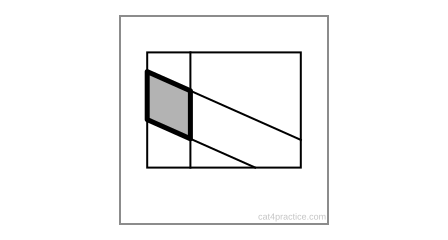
Which image hides the shape at the top? It is the same size and faces the same way: not turned round, and not a mirror image. Each of its sides is drawn in that image, as a whole line or as part of a longer line.
GL's rule is strict. The hidden shape must be "the exact same size outline of the target, including each side in full". And a copy that is a mirror image does not count.
Worked example

Check four things in each image: the shape, the size, which way it faces, and whether every side is drawn. The shape at the top has two upright sides (sides that go straight up and down) of the same length. Its top and bottom both slope down to the right.
The shape is at the left of A. Its left side is part of the left edge of image A: the black outline of each image counts as a line too. Its right side is part of the upright line, and its top and bottom are parts of the two sloping lines. It is the same size, it faces the same way, and all four sides are drawn.
B has the shape as a mirror image: its top and bottom slope up to the right. C has the same shape, but bigger. D has the two sloping lines and the left edge, but no upright line where the right side should be. Its upright line is far to the right, so the shape there is much wider. E has a shape of the same width, but its top and bottom slope much more steeply.
Answer: A. On paper, your child can trace each side with a finger. On a screen, they can trace each side with their eyes.
1 min 30 s, about the real test's pace
Question 22

Show the answer
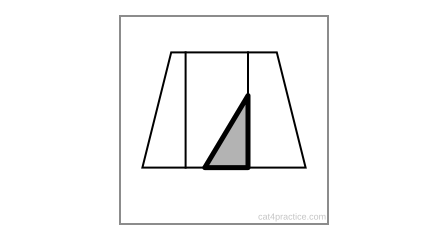
B. The triangle is in B, standing on the bottom edge. Its upright side is part of the upright line on the right, and its long side is the sloping line, which runs from the bottom edge up to that upright line. Its square corner is at the bottom right, as in the shape at the top.
A has the triangle as a mirror image: its square corner is at the bottom left. C has the same triangle, but bigger. D has a triangle of the same width, but not as tall. E has the triangle turned half way round: its square corner is at the top left.
Next time: Find the square corner first (here, at the bottom right). Then check how tall and how wide the triangle is.
Question 23

Show the answer
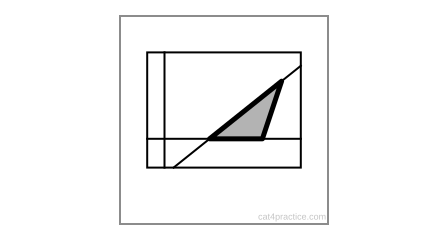
D. The triangle is in D, a little right of the middle, sitting on the line across. Its long side is part of the long sloping line, and its short side is the short line that joins the line across to the sloping line. Its top corner is further to the right than the right end of its bottom side, as in the shape at the top.
A has the triangle as a mirror image: its top corner is further to the left than the left end of its bottom side. B has the triangle as a mirror image from top to bottom, like its reflection in water: its bottom side is at the top. C has the same triangle, but bigger. E has a triangle whose short side goes straight up, so its top corner is right above the end of its bottom side, not further to the right.
Next time: Look at where the top corner of the shape is, compared with its bottom side. Here it is further to the right than the right end of the bottom side.
Question 24

Show the answer
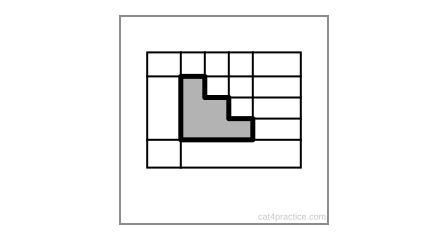
C. The staircase is in the middle of C. Its left side is part of the upright line near the left edge, and its bottom is part of the line across near the bottom. Each step is made by a line coming down from the top edge and a line going across. There are three steps, each as wide and as tall as in the shape at the top, going down to the right.
A has the staircase as a mirror image: its steps go down to the left. In B the second step has no upright side: the line from the top edge stops at the step's flat top. So the shape is not complete. D has the same staircase, but bigger. E has a staircase whose middle step is much narrower than the others.
Next time: Check every step: each one needs a flat top and an upright side, and each must be the same size as in the shape at the top.
Quick answer key
For marking a printed copy:
| Type of question | Answers |
|---|---|
| Figure classification | 1 C · 2 E · 3 C |
| Figure matrices | 4 D · 5 A · 6 C |
| Verbal classification | 7 D · 8 A · 9 E |
| Verbal analogies | 10 A · 11 B · 12 D |
| Number analogies | 13 B · 14 A · 15 E |
| Number series | 16 E · 17 D · 18 B |
| Figure analysis | 19 B · 20 D · 21 C |
| Figure recognition | 22 B · 23 D · 24 C |
What your child's result here tells you
No set of practice questions can give a CAT4 score. A real score compares your child with a large sample of children of the same age, chosen to represent the whole UK. Questions made at home cannot be compared with that sample. What these 24 questions can show you:
- Which types of question were new to your child. If the paper-folding questions needed explaining, and the next two then came easily, your child was meeting that type for the first time. That is exactly what practice is for.
- Whether the clock matters. If your child gets answers right with no clock but gets stuck with one, the thing to practise is moving on from a hard question, not doing more questions.
- Not how able your child is. Twenty-four questions at home are far too few to measure that.
Before the test: getting to know the questions
In our view, whatever the test is for, it helps if your child knows each type of question before the day. In the real test, there are a few practice questions before each test, and they have no clock. GL says these "will familiarise the children with the style and format of the questions".GL Assessment, CAT4: information for parents. This page gives your child three questions of each type to try earlier, at home.
GL, which sells CAT4 only to schools, advises against practice of any kind before the test. You can read GL's advice in its own words in our test guide.
The research: sitting a test again, and coaching
We found no published study of practice for CAT4 itself. Reasoning tests like CAT4 have been studied for many years. But none of the research below is about practising at home, so it does not tell you whether practice at home changes a score, or by how much. On CAT4's scale, 100 is average, and about half of all children score between 89 and 111.
| What was studied | Who was studied | Gain, on CAT4's scale |
|---|---|---|
| Taking a test a second time, with no coaching | 75 groups, 81,374 people, from school pupils to adults | about 3 points |
| Taking it again after some coaching (about 2½ hours, typically) | 23 groups in the same review | about 10 points |
| A second try, and a third try | 153,185 people for a second try, 23,977 for a third, in groups with an average age of 12 to 70 | about 4½ and 7 points |
| Coaching for reasoning and ability tests | 24 studies | about 6½ points |
The first and third rows are about sitting a test again; in the first, the people running the test gave and marked it, with no coaching in between. The second and fourth are about coaching, and the 10 points in the second include the gain from sitting the test again. The review behind the first two rows did not measure practice tests done alone at home, like the ones on this page.
We changed each study's result into points on CAT4's scale.Hausknecht, Halpert, Di Paolo and Moriarty Gerrard (2007), Retesting in selection, Journal of Applied Psychology 92 (authors' manuscript): 0.21 of a standard deviation for a retest without coaching (75 samples, 81,374 people) and 0.64 with coaching (23 samples, 2,323 people; median contact time about 2.5 hours), for the scores people got (Table 4; the review's text gives 0.24 and 0.70, after a correction for errors of measurement). CAT4's scale is set on the scores children get, so we use the figures for the scores people got. Scharfen, Peters and Holling (2018), Retest effects in cognitive ability tests, Intelligence 67: 0.327 for a second try (153,185 people) and 0.495 for a third (23,977 people), in samples whose average age was 12 to 70, already corrected in the same way. The correction divided each result by the square root of the test's reliability. The authors took the reliability to be 0.83 for most results, so its square root is about 0.91. We undid the correction by multiplying by 0.91 (about 0.30 and 0.45). Kulik, Bangert-Drowns and Kulik (1984), Effectiveness of coaching for aptitude tests, Psychological Bulletin 95: 0.43, across 24 studies; the summary we have does not say whether it was corrected. We multiplied each by 15, the standard deviation of the scores children get on CAT4. The change is ours, and it assumes that the results apply to CAT4 too.
Three more findings matter for parents.
- A fourth try or more raised scores no further. A paper on the An entrance test, taken at about age 10 or 11, for grammar schools: schools in parts of England, and in Northern Ireland, that choose pupils by test. also notes from earlier research that more practice and coaching add less and less. The 11+ is a test for places at grammar schools: schools in parts of England that choose their pupils by a test.
- When every child can get coaching, the order of the children hardly changes. In a study of the 11+ in Northern Ireland, coaching raised scores, but it did not much change the order of the pupils, as long as all of them could get coaching.
- Most of this research is on teenagers and adults. In one large review, more than 7 in 10 groups were at secondary school or university. Another included only groups whose average age was 12 or more. So the numbers for younger children are less certain.
Researchers studied the 11+ in Kent. State primary schools in Kent are asked not to prepare pupils for it. So, the researchers argue, the only children who get to know its reasoning questions are those whose parents help them practise, pay for a tutor, or send them to a private school.Allen, Bartley and Nye (2017), The 11-plus is a loaded dice, FFT Education Datalab (see further reading). On Northern Ireland: Allen and Bartley (2017), The role of the eleven-plus test papers, citing Bunting and Mooney (2001).
Other families
Some families do practise. A UAE newspaper reported that some parents help their children get to know the CAT4 format before the test. About half of pupils at private schools in Dubai get extra tutoring, some of it at their own school. In England and Wales, about 29 in 100 secondary school pupils have had a private tutor at some point. Not all of this is for CAT4, but it shows that many children get help outside school.
What we suggest
What we suggest depends on what the test is for. If you are not sure, ask the school. Our guide to CAT4 scores explains what a score can change for your child, such as sets and target grades.
| What the test is for | What we suggest |
|---|---|
| A test at the start of a new school, often in Year 7 | The plan below. A short, calm look at each type of question |
| A test for a place at a school, or a scholarship | The plan below, starting about three weeks before |
| A child new to UK-style tests, such as a child who has just moved from another country | Start with the worked examples, slowly, so that no type of question is new on the day |
| A child aged 6 to 8 | No practice papers. Games and puzzles, described below, use the same kinds of thinking |
A three-week plan
This plan is ours, and it is short on purpose. In the research above, scores stopped rising on average after a third sitting of a test, and a paper on the An entrance test, taken at about age 10 or 11, for grammar schools: schools in parts of England, and in Northern Ireland, that choose pupils by test. notes that more practice and coaching add less and less. None of it measured practice at home, so the length of this plan is our judgement. About 80 minutes over three weeks should be enough that no type of question is new to your child.
Long courses are another matter: in Northern Ireland, nine months of coaching raised scores a lot. We do not suggest them. In our view, beyond knowing the format, a child gains more from reading, puzzles and sleep.
The plan uses only this page, and it keeps one new question of each type for a timed try at the end, with the clock below the table.
| When | What to do | Time |
|---|---|---|
| Three weeks before | The eight worked examples together, with no clock. Then the first question of each type alone | Two sessions of 15 to 20 minutes |
| Two weeks before | The second question of each type, with no clock. Talk through every wrong answer | Two sessions of 15 minutes |
| One week before | The third question of each type, with a clock, at the real speed: 8 questions in about 3½ minutes. Practise moving on from a question that is taking too long | One session of 15 minutes, with the explanations after |
| The last few days | Nothing new |
Timed run: questions 3, 6, 9, 12, 15, 18, 21 and 24 in 3 min 30 s, about the real test's pace.
If your child wants more questions, books and websites sell them. GL does not "recommend or endorse any CAT4 practice materials". So check a few answers yourself before you trust a set. Any "score" such a set gives is a rough guide only, not a CAT4 score.
For the longer term, GL says that reasoning "can be developed through experience and practice". CAT4 uses words, numbers and shapes. So reading widely, working out sums in your head, and shape puzzles are good places to start.
Ages 6 to 8: games, not test papers
For younger children, the same kinds of thinking come up in play. None of it needs to feel like practice for a test.
- Paper snowflakes. Fold some paper, cut shapes into it, then say what the pattern will look like before you unfold it. This is the same idea as the paper-folding questions.
- Jigsaws, tangram puzzles (seven flat shapes that fit together into a square or into other shapes, such as a boat) and building toys with instructions, for imagining and turning shapes.
- Patterns to continue, first with beads or claps, then with numbers.
- Odd one out: put four things from around the house together, and ask which one does not belong, and why.
- Hidden-object puzzles, where your child finds small things hidden in a crowded scene, for finding a shape inside a bigger image.
CAT4 tomorrow? What to do tonight
Do only a little. If not knowing what to expect worries your child, try two or three worked examples together, then put the page away. A normal evening and a good night's sleep matter more.
Three reminders match GL's instructions to pupils: try every question, don't spend too long on a hard one, and if you're not sure, choose the answer you think is right. The The number of questions your child answered correctly. A wrong answer does not take marks away., the number of right answers, is what the test counts first, so a guess can only help.
On the day, each test has its own clock, and nobody moves on until it runs out. A child who finishes early waits, and GL asks teachers to encourage them to check their answers. But the clock never stops, so your child should not spend too long on one question. GL also tells pupils that "Some questions may be harder than others". A very hard question is normal.
Frequently asked questions
Are there official CAT4 practice tests? Not as separate tests. The official practice is inside the test itself: each test starts with practice questions that have no clock and can be repeated. GL also has a short training video for pupils with some example questions.
Are there CAT4 past papers? Not from GL. Only schools can buy the test. GL does not "recommend or endorse any CAT4 practice materials". So papers sold as "CAT4 past papers" cannot be the real test: someone else wrote the questions to look like CAT4.
Is there a free CAT4 practice PDF? Yes. Each of our level pages has a free PDF of its questions, with the answers at the back: see the list at the end of this page. To print the questions on this page, use your browser's "print" or "save as PDF" option. The answers under the questions do not print, but the quick answer key does, so you can mark the printed copy.
How many questions are in the real CAT4? GL does not say how many questions each test has. GL's teacher guidance lists the highest possible mark on each part, but names no level: 48 verbal, 48 non-verbal, 36 number and 36 spatial. A child gets one mark for each right answer, so the whole test probably has 168 questions. The test times add up to 72 minutes.
Does the CAT4 report say how my child prepared? No. A CAT4 report shows your child's scores and GL's predictions of later grades. We found nothing in GL's description of the report about how a child prepared. If you wish, you can tell your child's teacher that your child has seen the types of question before.
Is it cheating to practise? No. We found no rule against it, and our questions are not the real test: only schools can buy that. GL advises against practice, but the decision is yours.
My child gets nervous about tests. Will practice make it worse? Probably not, if it starts easy and with no clock.
A review of 24 studies of practice quizzes, mostly in classrooms, found that on average the quizzes made students less nervous about tests, not more.Yang, Li, Zhao, Luo and Shanks (2023), Educational Psychology Review (see further reading). The authors call the finding on easy quizzes "suggestive rather than conclusive". Easy quizzes seemed to help more than hard ones, though the researchers say this finding is not certain. They add that the quizzes themselves may feel more stressful than other ways of learning.
The quizzes were on what students were learning, some of them at university, not reasoning tests. So start with the worked examples, side by side, and add the clock only when your child feels ready.
All our CAT4 guides
Practice questions for your child's year
Worked examples and questions of each type, every answer explained. Each level page also has a PDF of its questions, with the answers. In Year 7 (Grade 6), we suggest starting with the Level D page, then the 24 questions for more practice.
- Year 7, Grade 6, Level D
- 24 free questions, all eight types, Years 6 and 7, Grades 5 and 6, This page
- Year 8, Grade 7, Level E
- Years 9 and 10, Grades 8 and 9, Level F
- Other years have no page yet. Our guide to the CAT4 test shows one example of each type of question. For Years 2 and 3 (Grades 1 and 2), we suggest games, not test papers.
About CAT4
- The CAT4 test, What your child will sit, the test day, and how schools use results
- CAT4 in the UAE, Which grades take it, at which level, and whether it affects admission
- CAT4 in Ireland, 6th class: which level, and why it cannot decide a school place
Your child's scores
- CAT4 scores explained, What a score of 100, 115 or 130 means, and what to ask the school
- CAT4 glossary, SAS, stanine, NPR and the other words on reports and school letters
Further reading
- Yang and others (2023), Do practice tests (quizzes) reduce or provoke test anxiety? This review brought together 24 studies of practice quizzes, mostly in classrooms and some with university students. On average, practice quizzes made students less anxious about tests, not more. Easy quizzes seemed to help more than hard ones.
- Allen, Bartley and Nye (2017), The 11-plus is a loaded dice. The title means that the test favours some children over others. A study of the 11+ in Kent. State primary schools in Kent are asked not to prepare pupils. So, the authors argue, only children whose parents help them practise, pay for tutors or choose private schools get to know the reasoning questions.
- Hausknecht and others (2007), Retesting in selection. A large review of what happens when people take a reasoning test twice. Scores rose the second time, and rose more with coaching. The people studied ranged from school pupils to adults.
Notes
-
GL Assessment, CAT4: information for parents. ↩
-
Hausknecht, Halpert, Di Paolo and Moriarty Gerrard (2007), Retesting in selection, Journal of Applied Psychology 92 (authors' manuscript): 0.21 of a standard deviation for a retest without coaching (75 samples, 81,374 people) and 0.64 with coaching (23 samples, 2,323 people; median contact time about 2.5 hours), for the scores people got (Table 4; the review's text gives 0.24 and 0.70, after a correction for errors of measurement). CAT4's scale is set on the scores children get, so we use the figures for the scores people got. Scharfen, Peters and Holling (2018), Retest effects in cognitive ability tests, Intelligence 67: 0.327 for a second try (153,185 people) and 0.495 for a third (23,977 people), in samples whose average age was 12 to 70, already corrected in the same way. The correction divided each result by the square root of the test's reliability. The authors took the reliability to be 0.83 for most results, so its square root is about 0.91. We undid the correction by multiplying by 0.91 (about 0.30 and 0.45). Kulik, Bangert-Drowns and Kulik (1984), Effectiveness of coaching for aptitude tests, Psychological Bulletin 95: 0.43, across 24 studies; the summary we have does not say whether it was corrected. We multiplied each by 15, the standard deviation of the scores children get on CAT4. ↩
-
Allen, Bartley and Nye (2017), The 11-plus is a loaded dice, FFT Education Datalab (see further reading). On Northern Ireland: Allen and Bartley (2017), The role of the eleven-plus test papers, citing Bunting and Mooney (2001). ↩
-
Yang, Li, Zhao, Luo and Shanks (2023), Educational Psychology Review (see further reading). The authors call the finding on easy quizzes "suggestive rather than conclusive". ↩